
Welcome, Helen Mireno, SEO Consultant and guest contributor!
SEO: It’s Basically Just Two Things

When you hear these letters – SEO – do you feel overwhelmed? I get that.
There are so many little and big ideas connected with SEO. So much advice. So many supposed hacks and “have-tos.” It feels impossible to learn everything.
Helen and Charlie Galaxy
But the idea of learning “everything” in SEO is a bit of a fiction. SEO is a moving target. So it’s best not to worry about everything. It’s more important to do a handful of good things and do them consistently.
So let’s narrow the scope, shall we?
Boiling Down SEO.
First of all, let’s get the definition out of the way.
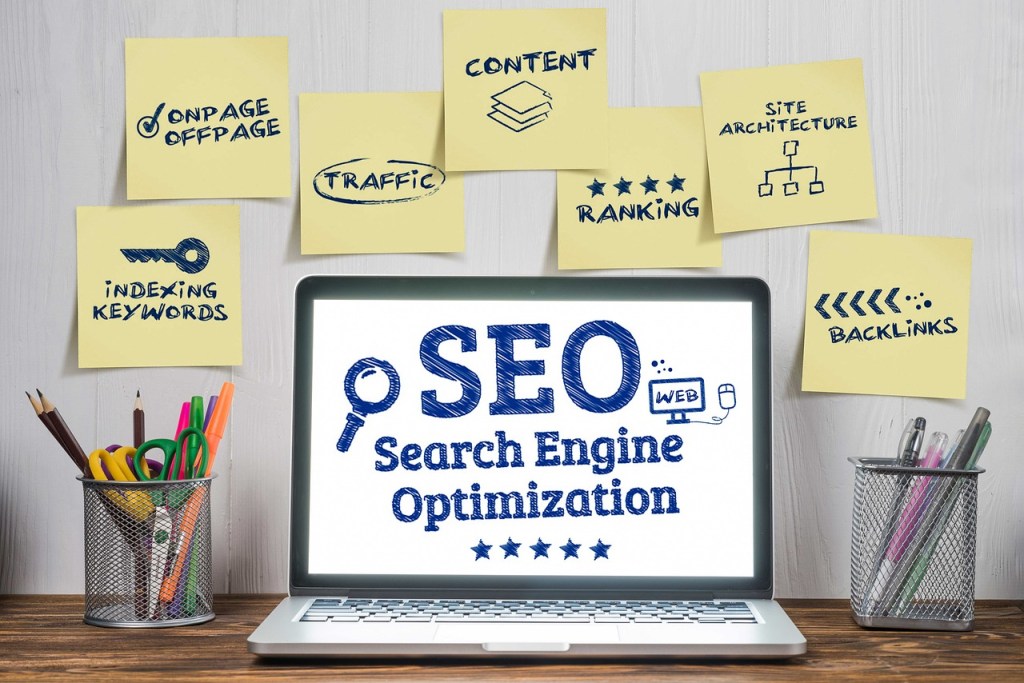
SEO stands for Search Engine Optimization. It’s basically the concrete actions you can take to get your website moving up in Google’s rankings.
Image by Diggity Marketing from Pixabay
In the end, those concrete actions boil down to two essential ideas:
- Make it easy for the search engine (Google) to understand your page.
- Make your content genuinely useful to people searching the internet.
That’s it. (Yes, seriously.) I mean, it’s a little broad brush, but essentially that’s SEO in a nutshell.
Make yourself clear to Google. Offer real value to the user.
In this blog, we’re going to talk about helping Google figure you out. And about giving users what they need to push you up the rankings.
How Google Ranks Your Stuff
Let’s get the search engine part of this nailed down first. How do Google rankings happen? How does it pick what goes first on that results page?
What you have to remember here is that the search engine’s priority isn’t you or your website.
All Google cares about is satisfying the person who’s using their search bar. It wants to give them the best pages possible to satisfy their query.
In order to do that, Google sends out the bots.
- Crawling – Search Engine web bots are always scouring the internet looking for clues. They crawl new pages, refreshed info, URLs, links, sitemaps, content, everything… to check out what each web page is about.
- Indexing – Once the bots suss out what they can from the clues, they index the sites accordingly. Basically, everything gets placed into a big reference library just for Google.
- Ranking – When a query is made by a user, Google turns to this neatly pre-organized and defined information. It then attempts to arrange it for the user in ranked order of relevance and quality.
This is why clarity is crucial. When you clearly describe your website to search engines, it helps match your content with the right audience.
A good way to make things crystal clear is by using keywords.
Keywords and the SEO Puzzle

Keywords are revealing words or phrases that accurately reflect the content of your page.
They’re woven into your copy and act almost like a secret code – a code that says, “Hey Google, here’s what this page is about.”
If you own a pet shop in San Angelo, you might choose keywords like “pet store” or “San Angelo pet shops.”
Take some time to research popular keywords. Which words have the highest search volume? Which ones have the lowest competition? Which are odd phrases that your clients are likely to use?
You have to use your imagination too. Put yourself in your client’s shoes. When your ideal customer sits at their computer, what do you think they’d type?
The most effective keywords are the ones that align your page’s content with the specific words your ideal customer uses in their search.
Keywords aren’t about just finding a popular word or phrase. They’re about finding the right expression that reflects your ideal client’s intentions.
The Dangers of Keyword Stuffing
All that being said, don’t go crazy. If your content reads like a chain of keywords over and over, just stuffed in for SEO mojo – that’s called keyword stuffing.
Don’t do it. You’ll only hurt your rankings.
“Attempting to manipulate search rankings with repeated uses of words or phrases will only cause a site to rank lower in Google’s search results,” advises Search Engine Journal, “Be wary of any advice that suggests otherwise.”
So, if you want to avoid punishment from the Google Gods, read your copy out loud. If it sounds normal, you’re probably safe.
If it sounds like a gumball machine spewing out the same word over and over… you’ve gone too far. Go back and take some out.
In general, the rule of thumb is to have your keyword make up about 1-2% of your copy.
Above all you want it to sound concise, natural, and compelling.
Taking Care of “Backstage”
In SEO there are some fussy, tiny tweaks that too often get ignored – especially in small business SEO. Most of these tiny fixes are on the back end of the website.

The back end is like your website’s backstage. While the front end showcases your website’s attractive pages with content and images, the back end houses the mechanisms that make the magic happen seamlessly.
Neglecting the “backstage” can really slow down the show.
But if you attend to these little chores, it can put you ahead of other sites that can’t be bothered.
Here are some little fixes that can yield big SEO:
- Optimize Your Title Tags and Meta Descriptions.
You’ve seen these a million times on your own Google searches.
Title tags are those boldface titles listed down a results page. The meta description is the brief summary of the page you see after the title.
If you don’t write your own, the search engine will do it for you.
It sort of snips together headlines and sentences from your site in an attempt to generate an identity for you for the ranked results. The result can be a sort of Frankenstein branding.
Create your own optimized title tag and meta description using some keywords. Write something to excite curiosity in the user.
This is your chance to create a relevant and appealing first impression which can improve your click-through rate. Which translates to more eyes on your site and better SEO.
- Check Your Load Time.
How quickly does your site load? A slow load time is something soooo many people overlook. It’s such a mistake.
According to Semrush, the average retail site’s load time is close to 7 seconds. But 40% of mobile users think that anything longer than 3 seconds is too long.
A clean, easy load is a big win that can really put you ahead of the SEO game.
- Optimize Your Photos.
Optimizing your photos isn’t just about SEO, it improves user experience. Which then…of course…improves your SEO.
So think about your users. Match your photo size to the site. Remember, images are great, but not when they wipe down the page like a curtain.
Compressing the images will decrease their file size and improve that dreaded load time.
Most of all, don’t forget to add Alt Texts for your images. Alt Texts are short descriptions of images that help visually impaired users understand them. It’s the right thing to do and also boosts your SEO.
- Format for Mobile.
Break up your text into smaller, bite-sized paragraphs.
Use bullet points (like I’m doing in this section).
Use boldfaced and italicized text to highlight important ideas.
Basically do everything you can to help the scrolling customer to find that nugget.
If your text is in big paragraphs – which is anything over 2-3 sentences on a mobile device – your users will get overwhelmed and immediately bounce off your site.
Make it easy for them to jump around, search, and interact with the page. Remember that around 63% of searches now happen on mobile. Make sure your site is formatted for those people.
You Need More Content
I hear a lot of people say they don’t want pages crammed with text because “people don’t like reading.” That’s not exactly right when you’re considering SEO.
Websites with fewer than 1000-ish words a page can be considered thin – and, no, that’s not a compliment.
Google doesn’t like thin websites. It sees them as low in value. Sending users there is like giving them a gift card to a store with empty shelves. Not worth it.
If the search engine sees lots of pages with a low word count, it assumes there’s not much to the site and flags it as “thin content” – which is SEO code for “useless.” You fall off the map.
The search engine wants juicy, rich sites to show to its users. Remember, the user came to Google with a question. It wants them to find everything they need on one site.
So when it comes to content, less is NOT more. It’s just less. Create pages that have a minimum of 1000 words. Good words. Useful words. Blogs. Resources. Case studies. Testimonials.
More is MORE.
User Experience Is the Main Thing
So let’s say you do everything right. You create a fabulous little trail of SEO breadcrumbs for Google and users to find you. They get their eyes on your pretty, fast-loading site. And then…
The content is thin.
Or weak.
Or misleading.
Or boring.
Or confusing.
Or just obnoxious.
Guess what? None of that other stuff’s going to matter now. The user will come. And then they’ll bounce.
And Google will remember that people don’t seem to stay long on your page.

So when people come to your site, give them something worth finding. Not just quantity, but quality. Consider their needs and always overdeliver.
- Answer their questions.
- Make them laugh.
- Offer rich content.
- Talk to them like humans.
- Make things easy.
- Have their best interests in mind.
- Make the next step super clear.
In short, be a good host.
Create a website where people want to stay, look around, and ultimately take action. Be professional and engaging. Warm, relevant, authentic, and generous.
The more you offer, the more you’ll matter. To Google and – most importantly – to your new, favorite client. And in the end, mattering to your client is what it’s all about.
Resources:
Statista, Mobile share of U.S. organic search engine visits 2013-2021,
Helen Merino is an SEO Consultant specializing in optimized web content for the pet industry. She writes compelling, relevant, and positive copy for veterinary and pet care-related businesses. Like me, she’s an animal welfare advocate and pet mom.

 Tiffani Hill LLC